 Distributors List
 Contact Us



When researching machine safety, you will encounter the term “DCavg (Average Diagnostic Coverage).” As you read further, you will come across another indicator “Performance Level (PL),” which might make things seem increasingly complicated.
However, these two concepts are not separate ideas, but are closely connected. Let’s look at them step by step.
DCavg (Average Diagnostic Coverage)
First, in simple terms, DCavg is “the percentage of dangerous failures that a machine can detect on its own out of the total number of dangerous failures occurring in itself.”
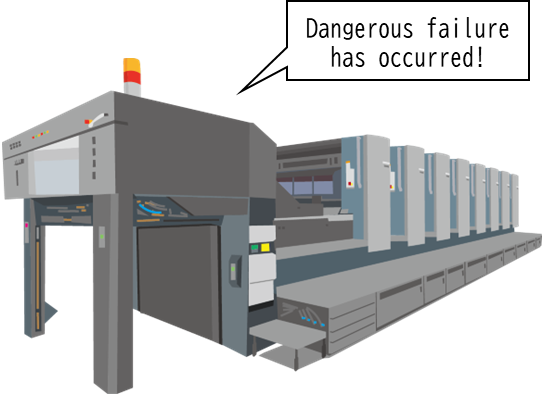
Machines will encounter various troubles (failures) as they are used, such as:
- sensors may stop detecting
- wirings may break
- switches may fail
When these failures occur, it is important whether the machine can detect (diagnose) them on its own.
Suppose 10 failures occurred in a machine:
- 9 were detected → DCavg 90%
- Only 5 were detected → DCavg 50%
This is a general idea.
DCavg numerically represents “how many abnormal conditions can be detected without being missed.”
Why does it matter?
The point here is “whether the failure can be detected,” rather than “occurrence of the failure.” This is because continuing to use the machine without realizing the failure can lead to accidents.
For example,
- the machine does not stop even though the door is open.
- the machine continues to operate even though the sensor is not working.
You may see this is extremely dangerous.
On the other hand, if failures can be detected immediately, it is possible to
- stop the machine
- activate an alarm
so that accidents can be prevented.
Is a higher DCavg necessarily safer?
Basically, that is correct.
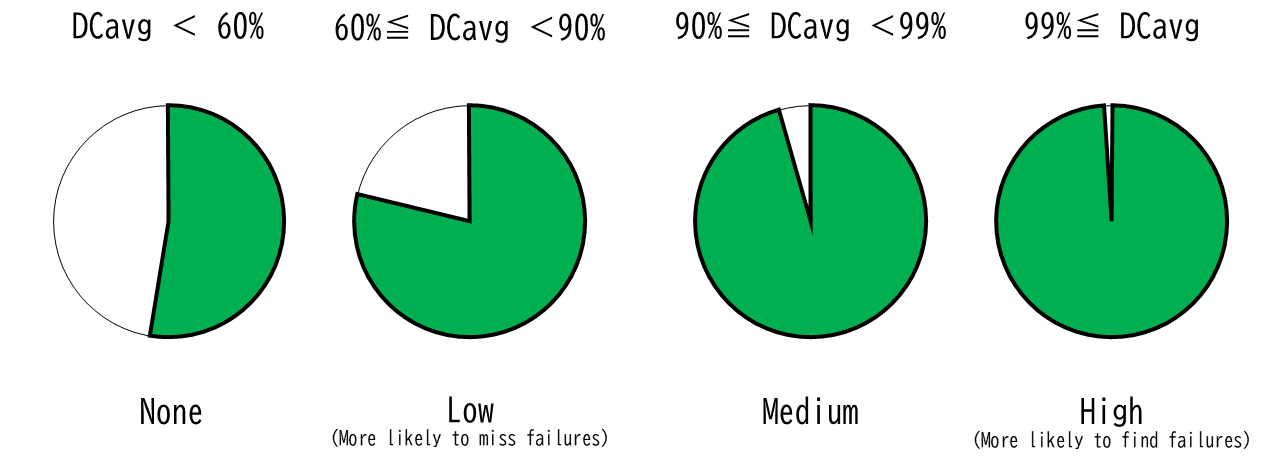
- Low DCavg → More likely to miss failures
- High DCavg → More likely to find failures
As general benchmarks, DCavg is often classified as follows:
- DCavg < 60%: None
- 60% ≦ DCavg < 90%: Low
- 90% ≦ DCavg < 99%: Medium
- 99% ≦ DCavg: High
What is Performance Level (PL)?
The next is PL, which represents a rank of “how reliable the safety function is.”
The rank is shown as follows. As the rank gets closer to e, the safety is evaluated higher.
- PL a (Low)
- PL b
- PL c
- PL d
- PL e (High)
What determines PL?
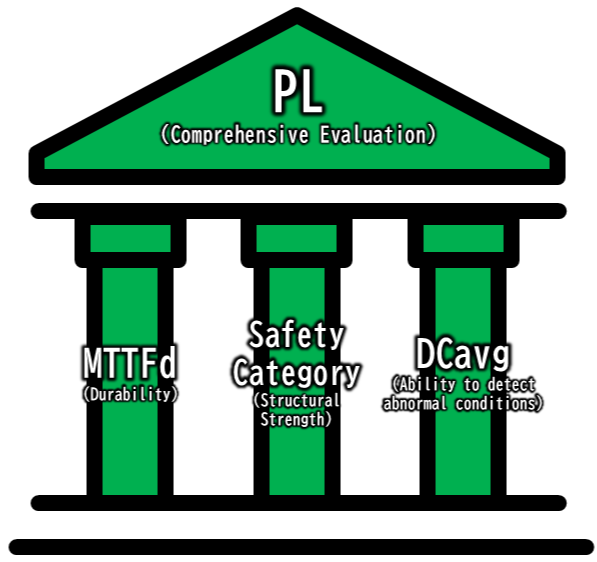
PL is primarily determined by the three factors below:
- MTTFd (durability)
- Safety Category (structural safety)
- DCavg (failure detection ability)
Of these, DCavg is the factor in charge of “the ability to detect abnormal conditions.”
The impact of DCavg on PL
This is the most important point.
The higher the DCavg, the easier it is to achieve a high PL.
This is because:
- The proportion of detectable dangerous failures increases.
- The proportion of undetectable dangerous failures decreases.
Consequently, it will lead to improved reliability of safety function. For example,
Low DCavg
- Faults frequently not detected
- Dangerous failures easily overlooked
→ Difficult to achieve high PL
High DCavg
- Wider range of fault detection
- Dangerous failures less likely overlooked
→ Possible to aim at high PL (d or e)
However, it is not determined by “DCavg alone”
This point tends to be misunderstood. A high DCavg does not necessarily mean a high PL.
In the following cases, for example, the entire safety cannot be considered sufficient even if the detection capability is high:
- The component is fragile (Low MTTFd)
- The structure is too simple (Low Safety Category)

To put it simply
PL is a “comprehensive evaluation.”
- MTTFd: durability
- Safety Category: structural strength
- DCavg: ability to detect abnormal conditions
It is only when these three factors are well-balanced that a high PL is achieved.
How can DCavg be increased?
To increase DCavg, it is necessary to increase the number of “fault detection (diagnosis) mechanisms.”
The following ingenuities, for example, can decrease the chances of missing a failure (or increase the possibility of detecting abnormal conditions):
- Check the presence of faults by sending test signals periodically
- Compare input and output (Cross check)
- Make two circuits, which perform the same operation, monitor each other
These mechanisms are also used in actual safety devices. For example, although the diagnostic capabilities of safety switches are different between products in the market, the types with internal redundancy and cross-monitoring functions can contribute to enhancing “performance to detect abnormal conditions” of the overall safety functions, thereby helps establish safety functions complying with high PL.
Summary
DCavg (Average Diagnostic Coverage) is the “percentage of dangerous failures that a machine can detect on its own.”
To manufacture a safe machine, it is very important not only that “it is durable” but also that “it is able to properly detect failures when they occur.”
And, Performance Level (PL) represents “how reliable the safety function is.”
The relationship between DCavg and PL is simple.
The higher the DCavg, the easier it is to aim at a higher PL.
However, it is important that PL is determined not only by DCavg, but also by the balance with durability (MTTFd) and structure (Safety Category).
Appendix: Difference between DC and DCavg
- DC (Diagnostic Coverage): How well a specific type of failure can be detected
- DCavg (Average Diagnostic Coverage): Average detectability across various failures
Suppose there are three kinds of failures in a machine.
| Type of Failure | Detectable Ratio (DC) |
| Wiring breakage | 100% |
| Sensor failure | 80% |
| Contact welding | 40% |
“Individual detection capabilities” (100%, 80%, 40%) are DC.
In reality, however, it is necessary to evaluate “how well can the entire machine detect?” To achieve this, average of these values is calculated as DCavg.
(NOTE: In practice, it is not a simple average, but the probability of failure is also considered. For illustrative purposes, let us assume it as an average.)
This is a somewhat extreme example, but the relationship can be illustrated as follows:
- DC: Test score for each subject (math 80 points, science 60 points, …)
- DCavg: Overall average score (70 points)
In other words, DCavg represents how well abnormal conditions can be detected as a whole system.
Related Products

 FAX: +81-3-3710-4552
 FAQ
FAQ
 Discontinued Models